



Online CPE
- Courses are valid for CPAs, EAs, and tax preparers in all 50 states!
- AFSP/IRS and CTEC approved (see Overview).
- Satisfaction rating for our courses averages 4.95 out of 5.
Choose Credit Package
20 Online CPE Hours
$249
8 Online CPE Hours
$159
2 Online CPE Hours
$69
About the Online CPE
| CPE Course | CPE Hours | New | Availability | Limited Time+ | IRS Category | NASBA Category |
|---|---|---|---|---|---|---|
|
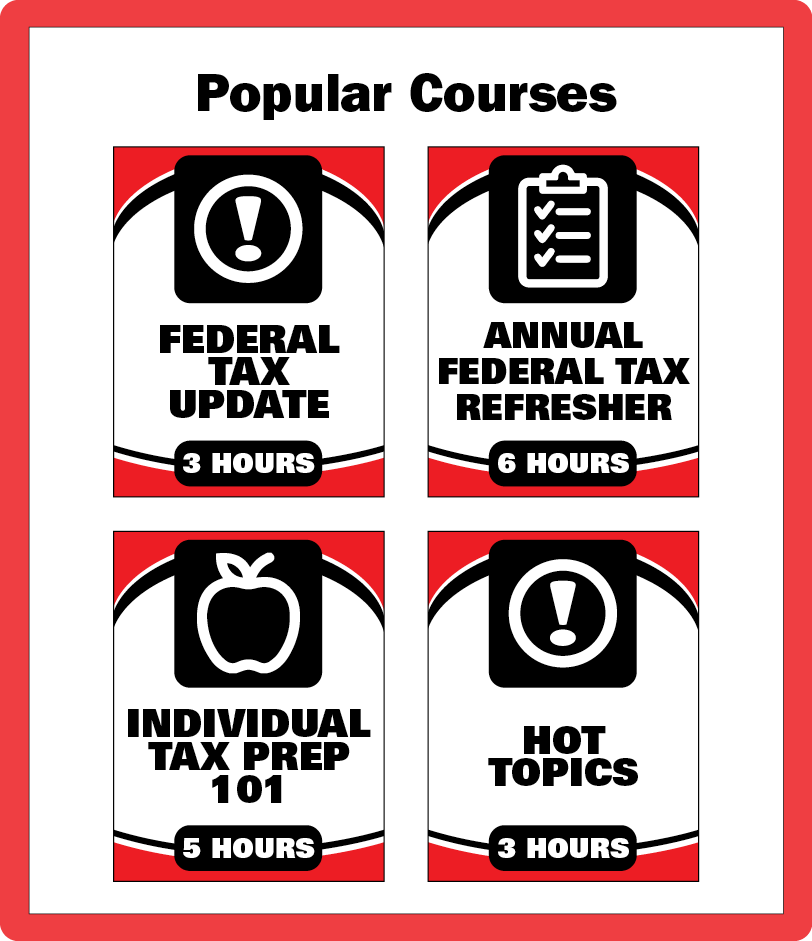
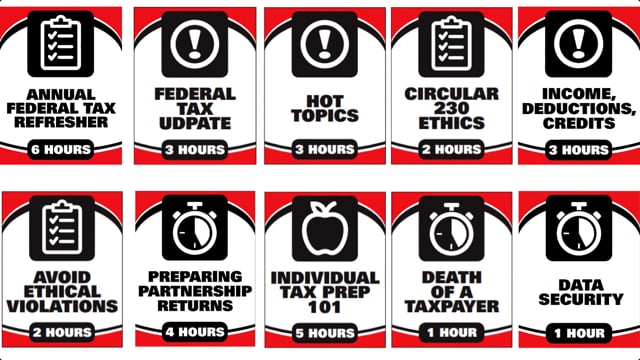
Annual Federal Tax Refresher
|
6 | Now | Federal Tax Refresher | Taxes | ||
Course ContentProgram content includes textual explanations of tax concepts in the context of a refresher course for tax professionals who are familiar with filing Form 1040 for individual taxpayers. The course meets requirements for the IRS Annual Federal Tax Refresher Course (AFTR).
CPE Credit Hours6 Credit Hours. One 50-minute period equals one CPE Credit Hour. Learning Objectives
Recommended ParticipantsTax professionals who prepare individual income tax returns are encouraged to participate in this course. Credits for this course are not available to Enrolled Agents. Program LevelReview. This course provides a general overview of the subject area from a broad perspective. It is appropriate for tax professionals at all organization levels. PrerequisitesIndividuals who have prepared Form 1040 tax returns. Advance PreparationNo advanced preparation is needed to complete this course. Delivery MethodQAS™ self-study. IRS Program Number7VT8K-A-00389-26-S NASBA Field of StudyTaxes. National Registry of CPE Sponsors ID Number109322 CTEC Course Number6193-CE-00116 Complaint Resolution PolicyPlease contact our customer service department toll-free at 1-866-919-5277. Refund PolicyFor information about our refund, complaint, and/or program cancellation policies, visit our website at www.thetaxbook.com/cpepolicy. |
||||||
|
California Tax for CRTPs
|
5 | Now | California Only | Taxes | ||
Course ContentThis course covers rules specific to California income tax returns. Program content includes residency rules for individuals, 2025 filing requirements, community property rules, deductions, adjustments, credits, AMT, and other taxes. CPE Credit Hours5 Credit Hours. One 50-minute period equals one CPE Credit Hour. Learning Objectives
Recommended ParticipantsIndividuals who prepare California income tax returns are encouraged to participate in this course. Program LevelOverview. This course provides a general overview of the subject area from a broad perspective. It is appropriate for tax professionals at all organization levels. PrerequisitesIndividuals with a basic knowledge of preparing federal Form 1040, U.S. Individual Income Tax Return. Advance PreparationNo advanced preparation is needed to complete this course. Delivery MethodQAS™ self-study. IRS Program NumberN/A NASBA Field of StudyTaxes. National Registry of CPE Sponsors ID Number109322 CTEC Course Number6193-CE-00115 Complaint Resolution PolicyPlease contact our customer service department toll-free at 1-866-919-5277. Refund PolicyFor information about our refund, complaint, and/or program cancellation policies, visit our website at www.thetaxbook.com/cpepolicy. |
||||||
|
Individual Tax Prep 101
|
5 | Now | Federal Tax Law | Taxes | ||
Course ContentThis course provides continuing professional education (CPE) to review basic information about preparing income tax returns for individuals. Subject matter includes information about filing status, dependents, income, adjustments, deductions, and tax credits for individuals. CPE Credit Hours5 Credit Hours. One 50-minute period equals one CPE Credit Hour. Learning Objectives
Recommended ParticipantsTax professionals who prepare individual income tax returns are encouraged to participate in this course. Program LevelOverview. This course provides a general overview of the subject area from a broad perspective. It is appropriate for tax professionals at all organization levels. PrerequisitesNone. Advance PreparationNo advanced preparation is needed to complete this course. Delivery MethodQAS™ self-study. IRS Program Number7VT8K-T-00399-26-S NASBA Field of StudyTaxes. National Registry of CPE Sponsors ID Number109322 CTEC Course Number6193-CE-00077 Complaint Resolution PolicyPlease contact our customer service department toll-free at 1-866-919-5277. Refund PolicyFor information about our refund, complaint, and/or program cancellation policies, visit our website at www.thetaxbook.com/cpepolicy. |
||||||
|
Advanced Business Topics
|
4 | Now | Federal Tax Law | Taxes | ||
Course ContentThis course provides continuing professional education (CPE) for tax professionals to enhance competence in preparation of tax returns containing specialized transactions in such areas as depreciation, payroll, and gain or loss from the disposition of business property, as well as issues relating to personal service corporations, personal holding companies, excess net passive income tax, and accumulated earnings tax. CPE Credit Hours4 Credit Hours. One 50-minute period equals one CPE Credit Hour. Learning Objectives
Recommended ParticipantsTax professionals who prepare individual income tax returns are encouraged to participate in this course. Program LevelAdvanced. This course provides information on a level most useful for individuals with mastery of the particular topic. It will focus on the development of in-depth knowledge, a variety of skills, or a broader range of applications, and is appropriate for seasoned tax professionals as well as other professionals with specialized knowledge in the subject area. PrerequisitesIndividuals who have prepared business tax returns. Advance PreparationNo advanced preparation is needed to complete this course. Delivery MethodQAS™ self-study. IRS Program Number7VT8K-T-00391-26-S NASBA Field of StudyTaxes. National Registry of CPE Sponsors ID Number109322 CTEC Course Number6193-CE-00011 Complaint Resolution PolicyPlease contact our customer service department toll-free at 1-866-919-5277. Refund PolicyFor information about our refund, complaint, and/or program cancellation policies, visit our website at www.thetaxbook.com/cpepolicy. |
||||||
|
Clients With Dependents
|
4 | Now | Federal Tax Law | Taxes | ||
Course ContentThis course provides continuing professional education (CPE) to enhance competence in preparing income tax returns for individuals. Subject matter includes information about the effect of claiming children and other qualifying persons as dependents on deductions, credits, and filing status. CPE Credit Hours4 Credit Hours. One 50-minute period equals one CPE Credit Hour. Learning Objectives
Recommended ParticipantsTax professionals who prepare individual income tax returns are encouraged to participate in this course. Program LevelOverview. This course provides a general overview of the subject area from a broad perspective. It is appropriate for tax professionals at all organization levels. PrerequisitesIndividuals who have prepared Form 1040 tax returns. Advance PreparationNo advanced preparation is needed to complete this course. Delivery MethodQAS™ self-study. IRS Program Number7VT8K-T-00394-26-S NASBA Field of StudyTaxes. National Registry of CPE Sponsors ID Number109322 CTEC Course Number6193-CE-00071 Complaint Resolution PolicyPlease contact our customer service department toll-free at 1-866-919-5277. Refund PolicyFor information about our refund, complaint, and/or program cancellation policies, visit our website at www.thetaxbook.com/cpepolicy. |
||||||
|
Individual Tax Prep 201
|
4 | Now | Federal Tax Law | Taxes | ||
Course ContentThis course provides continuing professional education (CPE) to review basic information about preparing income tax returns for individuals. Subject matter includes information about income, adjustments, deductions, and tax credits for individuals. CPE Credit Hours4 Credit Hours. One 50-minute period equals one CPE Credit Hour. Learning Objectives
Recommended ParticipantsTax professionals who prepare individual income tax returns are encouraged to participate in this course. Program LevelIntermediate. This course provides information on a knowledge level that builds on a basic program and will be most beneficial for tax professionals with detailed knowledge in the area. Such persons are often mid-level personnel with operational and/or supervisory responsibilities. PrerequisitesIndividuals who have prepared Form 1040 returns. Advance PreparationNo advanced preparation is needed to complete this course. Delivery MethodQAS™ self-study. IRS Program Number7VT8K-T-00410-26-S NASBA Field of StudyTaxes. National Registry of CPE Sponsors ID Number109322 CTEC Course Number6193-CE-00123 Complaint Resolution PolicyPlease contact our customer service department toll-free at 1-866-919-5277. Refund PolicyFor information about our refund, complaint, and/or program cancellation policies, visit our website at www.thetaxbook.com/cpepolicy. |
||||||
|
Introduction to Business Entities
|
4 | Now | Federal Tax Law | Taxes | ||
Course ContentThis course provides continuing professional education (CPE) for tax professionals to review basic tax information about business entities, including sole proprietorships, LLCs, partnerships, and corporations. CPE Credit Hours4 Credit Hours. One 50-minute period equals one CPE Credit Hour. Learning Objectives
Recommended ParticipantsTax professionals with limited knowledge of business entities who wish to expand their understanding of business entity taxation are encouraged to participate in this course. Program LevelOverview. This course provides a general overview of the subject area from a broad perspective. It is appropriate for tax professionals at all organization levels. PrerequisitesIndividuals who have some knowledge of basic tax law. Advance PreparationNone. Delivery MethodQAS™ self-study. IRS Program Number7VT8K-T-00401-26-S NASBA Field of StudyTaxes. National Registry of CPE Sponsors ID Number109322 CTEC Course Number6193-CE-00110 Complaint Resolution PolicyPlease contact our customer service department toll-free at 1-866-919-5277. Refund PolicyFor information about our refund, complaint, and/or program cancellation policies, visit our website at www.thetaxbook.com/cpepolicy. |
||||||
|
Preparing Partnership Returns
|
4 | Now | Federal Tax Law | Taxes | ||
Course ContentThe course provides continuing professional education (CPE) to enhance competence in preparing income tax returns for partnerships. Subject matter includes basics of partnership taxation, preparation of Form 1065, U.S. Return of Partnership Income, accompanying forms and schedules, flow-through income and deductions for partners, and end of a partnership. CPE Credit Hours4 Credit Hours. One 50-minute period equals one CPE Credit Hour. Learning Objectives
Recommended ParticipantsTax professionals who want to learn to prepare partnership tax returns are encouraged to participate in this course. Program LevelIntermediate. This course provides information on a knowledge level that builds on a basic program and will be most beneficial for tax professionals with detailed knowledge in the area. Such persons are often mid-level personnel with operational and/or supervisory responsibilities. PrerequisitesIndividuals who are familiar with tax rules regarding treatment of business income and expenses for sole proprietors filing Schedule C (Form 1040), Profit or Loss from Business. Advance PreparationNo advanced preparation is needed to complete this course. Delivery MethodQAS™ self-study. IRS Program Number7VT8K-T-00388-26-S NASBA Field of StudyTaxes. National Registry of CPE Sponsors ID Number109322 CTEC Course Number6193-CE-00038 Complaint Resolution PolicyPlease contact our customer service department toll-free at 1-866-919-5277. Refund PolicyFor information about our refund, complaint, and/or program cancellation policies, visit our website at www.thetaxbook.com/cpepolicy. |
||||||
|
Federal Tax Law Update
|
3 | Now | Tax Law Updates | Taxes | ||
Course ContentThis course provides continuing education (CPE) to enhance understanding of the latest developments in federal income tax law. Subject matter includes inflation adjusted items, IRS postmark date, itemized deductions, theft loss deduction for scam victims, qualified business income deduction, Form 1099-K reporting rules, dependent care assistance program, Form 1099-MISC or Form 1099-NEC reporting changes, C corporation charitable contribution deduction, Trump Accounts, casualty loss deduction, Child and Dependent Care Credit, charitable contribution limit for itemizers and nonitemizers, and health savings account changes. CPE Credit Hours3 Credit Hours. One 50-minute period equals one CPE Credit Hour. Learning Objectives
Recommended ParticipantsTax professionals who prepare individual tax returns. Program LevelUpdate. This course provides a general review of new developments in taxation. It is appropriate for tax professionals at all organization levels. PrerequisitesIndividuals who have prepared Form 1040 tax returns. Advance PreparationNo advanced preparation is needed to complete this course. Delivery MethodQAS™ self-study. IRS Program Number7VT8K-U-00397-26-S NASBA Field of StudyTaxes. National Registry of CPE Sponsors ID Number109322 CTEC Course Number6193-CE-00080 Complaint Resolution PolicyPlease contact our customer service department toll-free at 1-866-919-5277. Refund PolicyFor information about our refund, complaint, and/or program cancellation policies, visit our website at www.thetaxbook.com/cpepolicy. |
||||||
|
Hot Topics
|
3 | Now | Federal Tax Law | Taxes | ||
Course ContentThis course provides continuing education to enhance understanding of Schedule 1-A (Form 1040), Additional Deductions, clients with unpaid taxes, and married taxpayer issues. Subject matter includes calculating and recognizing qualifications for the deductions available on Schedule 1-A (Form 1040), Additional Deductions, including the no tax on tips deduction, no tax on overtime deduction, no tax on car loan interest deduction, and the enhanced deduction for seniors, various penalties the IRS might impose on a taxpayer, ways a taxpayer might pay and/or settle their tax debt with the IRS, innocent spouse relief, injured spouse, community property rules, married filing separately provisions, and filing status when a spouse is a nonresident alien spouse. CPE Credit Hours3 Credit Hours. One 50-minute period equals one CPE Credit Hour. Learning Objectives
Recommended ParticipantsTax professionals who prepare individual income tax returns are encouraged to participate in this course. Program LevelOverview. This course provides a general overview of the subject area from a broad perspective. It is appropriate for tax professionals at all organization levels. PrerequisitesIndividuals who have prepared Form 1040 tax returns. Advance PreparationNo advanced preparation is needed to complete this course. Delivery MethodQAS™ self-study. IRS Program Number7VT8K-T-00398-26-S NASBA Field of StudyTaxes. National Registry of CPE Sponsors ID Number109322 CTEC Course Number6193-CE-00087 Complaint Resolution PolicyPlease contact our customer service department toll-free at 1-866-919-5277. Refund PolicyFor information about our refund, complaint, and/or program cancellation policies, visit our website at www.thetaxbook.com/cpepolicy. |
||||||
|
Avoid Ethical Violations
|
2 | Now | Ethics | Regulatory Ethics* | ||
Course ContentThis course provides continuing professional education (CPE) for tax practitioners to assist in avoiding sanctions for failure to comply with regulations governing the practice of tax preparers before the IRS. Subjects include disciplinary sanctions imposed on tax practitioners by the Office of Professional Responsibility and cases brought against tax practitioners for failing to file federal tax returns or remit funds for payment of taxes, assisting in understatement of tax, executing tax fraud, asserting frivolous positions, and aiding and abetting another person to practice before the IRS during a period of suspension. CPE Credit Hours2 Credit Hours. One 50-minute period equals one CPE Credit Hour. Learning Objectives
Recommended ParticipantsTax professionals who represent taxpayers before the Internal Revenue Service, or individuals who are preparing to become enrolled to represent taxpayers. Program LevelOverview. This course provides a general overview of the subject area from a broad perspective. It is appropriate for tax professionals at all organization levels. PrerequisitesNone. Advance PreparationNo advanced preparation is needed to complete this course. Delivery MethodQAS™ self-study. IRS Program Number7VT8K-E-00392-26-S NASBA Field of StudyRegulatory Ethics. Note: All jurisdictions accept courses from Registry sponsors to a certain extent. However, some jurisdictions have additional requirements. You can see which jurisdictions have these requirements at: https://www.nasbaregistry.org/cpe-requirements National Registry of CPE Sponsors ID Number109322 CTEC Course Number6193-CE-00012 Complaint Resolution PolicyPlease contact our customer service department toll-free at 1-866-919-5277. Refund PolicyFor information about our refund, complaint, and/or program cancellation policies, visit our website at www.thetaxbook.com/cpepolicy. |
||||||
|
Basics of Depreciation
|
2 | Now | Federal Tax Law | Taxes | ||
Course ContentThis course provides continuing professional education (CPE) to enhance competency in preparing tax returns for individuals with a small business or rental property. Subject matter includes identifying depreciable property, basis, qualifying property for the Section 179 deduction and special depreciation allowance, repairs and improvements, computing depreciation, recovery periods, applicable conventions, and depreciation recapture. CPE Credit Hours2 Credit Hours. One 50-minute period equals one CPE Credit Hour. Learning Objectives
Recommended ParticipantsTax professionals who prepare tax returns requiring depreciation computations are encouraged to participate in this course. Program LevelOverview. This course provides a general overview of the subject area from a broad perspective. It is appropriate for tax professionals at all organization levels. PrerequisitesIndividuals who have prepared Form 1040 tax returns with Schedule C, Schedule E, or Schedule F. Advance PreparationNo advanced preparation is needed to complete this course. Delivery MethodQAS™ self-study. IRS Program Number7VT8K-T-00407-26-S NASBA Field of StudyTaxes. National Registry of CPE Sponsors ID Number109322 CTEC Course Number6193-CE-00120 Complaint Resolution PolicyPlease contact our customer service department toll-free at 1-866-919-5277. Refund PolicyFor information about our refund, complaint, and/or program cancellation policies, visit our website at www.thetaxbook.com/cpepolicy. |
||||||
|
Circular 230 Ethics
|
2 | Now | Ethics | Regulatory Ethics* | ||
Course ContentThis course provides continuing professional education (CPE) to enhance understanding of regulations governing the practice of Enrolled Agents, CPAs, attorneys, and other individuals who prepare tax returns for compensation. Subject matter includes information about requirements to obtain a preparer tax identification number (PTIN), eligibility for enrollment to practice before the IRS, conduct in representation, violations of regulations, and disciplinary proceedings. CPE Credit Hours2 Credit Hours. One 50-minute period equals one CPE Credit Hour. Learning Objectives
Recommended ParticipantsTax professionals who represent taxpayers before the Internal Revenue Service, or individuals who are preparing to become enrolled to represent taxpayers. Program LevelOverview. This course provides a general overview of the subject area from a broad perspective. It is appropriate for tax professionals at all organization levels. PrerequisitesNone. Advance PreparationNo advanced preparation is needed to complete this course. Delivery MethodQAS™ self-study. IRS Program Number7VT8K-E-00393-26-S NASBA Field of StudyRegulatory Ethics. Note: All jurisdictions accept courses from Registry sponsors to a certain extent. However, some jurisdictions have additional requirements. You can see which jurisdictions have these requirements at: https://www.nasbaregistry.org/cpe-requirements National Registry of CPE Sponsors ID Number109322 CTEC Course Number6193-CE-00006 Complaint Resolution PolicyPlease contact our customer service department toll-free at 1-866-919-5277. Refund PolicyFor information about our refund, complaint, and/or program cancellation policies, visit our website at www.thetaxbook.com/cpepolicy. |
||||||
|
Disclosing Client Information
|
2 | Now | Ethics | Regulatory Ethics* | ||
Course ContentThis course provides continuing professional education (CPE) to enhance understanding of rules that apply to disclosure and use of client tax return information by a tax return preparer. Subject matter includes allowable disclosure and use, as well as the wording and manner of obtaining mandatory consents from clients to disclose or use their tax return information. CPE Credit Hours2 Credit Hours. One 50-minute period equals one CPE Credit Hour. Learning Objectives
Recommended ParticipantsTax professionals who prepare tax returns or otherwise have access to taxpayer information obtained as part of a tax preparation engagement. Program LevelOverview. This course provides a general overview of the subject area from a broad perspective. It is appropriate for tax professionals at all organization levels. PrerequisitesNone. Advance PreparationNo advanced preparation is needed to complete this course. Delivery MethodQAS™ self-study. IRS Program Number7VT8K-E-00377-25-S NASBA Field of StudyRegulatory Ethics. Note: All jurisdictions accept courses from Registry sponsors to a certain extent. However, some jurisdictions have additional requirements. You can see which jurisdictions have these requirements at: https://www.nasbaregistry.org/cpe-requirements National Registry of CPE Sponsors ID Number109322 CTEC Course Number6193-CE-00035 Complaint Resolution PolicyPlease contact our customer service department toll-free at 1-866-919-5277. Refund PolicyFor information about our refund, complaint, and/or program cancellation policies, visit our website at www.thetaxbook.com/cpepolicy. |
||||||
|
Estates
|
2 | Now | Federal Tax Law | Taxes | ||
Course ContentThis course provides continuing professional education (CPE) to enhance knowledge of the taxation of estates. Topics include personal representatives, when an estate begins, inherited property, estate filing requirements, and Form 1041, U.S. Income Tax Return for Estates and Trusts. CPE Credit Hours2 Credit Hours. One 50-minute period equals one CPE Credit Hour. Learning Objectives
Recommended ParticipantsTax professionals who prepare individual income tax returns are encouraged to participate in this course. Program LevelOverview. This course provides a general overview of the subject area from a broad perspective. It is appropriate for tax professionals at all organization levels. PrerequisitesNone. Advance PreparationNo advanced preparation is needed to complete this course. Delivery MethodQAS™ self-study. IRS Program Number7VT8K-T-00396-26-S NASBA Field of StudyTaxes. National Registry of CPE Sponsors ID Number109322 CTEC Course Number6193-CE-00082 Complaint Resolution PolicyPlease contact our customer service department toll-free at 1-866-919-5277. Refund PolicyFor information about our refund, complaint, and/or program cancellation policies, visit our website at www.thetaxbook.com/cpepolicy. |
||||||
|
Qualified Business Income Deduction
|
2 | Now | Federal Tax Law | Taxes | ||
Course ContentThis course provides continuing professional education (CPE) to enhance understanding of the qualified business income deduction. Subject matter includes information on who qualifies for the deduction, what qualified business income is, specified service trades or businesses, relevant pass-through entities, computing the deduction, thresholds, limitations, and aggregation. CPE Credit Hours2 Credit Hours. One 50-minute period equals one CPE Credit Hour. Learning Objectives
Recommended ParticipantsTax professionals who prepare individual income tax returns are encouraged to participate in this course. Program LevelIntermediate. This course provides information on a knowledge level that builds on a basic program and will be most beneficial for tax professionals with detailed knowledge in the area. Such persons are often mid-level personnel with operational and/or supervisory responsibilities. PrerequisitesIndividuals who have prepared Form 1040 tax returns. Advance PreparationNo advanced preparation is needed to complete this course. Delivery MethodQAS™ self-study. IRS Program Number7VT8K-T-00409-26-S NASBA Field of StudyTaxes. National Registry of CPE Sponsors ID Number109322 CTEC Course Number6193-CE-00122 Complaint Resolution PolicyPlease contact our customer service department toll-free at 1-866-919-5277. Refund PolicyFor information about our refund, complaint, and/or program cancellation policies, visit our website at www.thetaxbook.com/cpepolicy. |
||||||
|
Real Estate and Rental Activities
|
2 | Now | Federal Tax Law | Taxes | ||
Course ContentThe course provides continuing professional education (CPE) for tax professionals to enhance competence in preparation of tax returns for clients with rental real estate activities. Subjects include the tax treatment of rental real estate including income, expenses, depreciation, at-risk limitations, passive loss limitations, and gain or loss from the sale of rental real estate. CPE Credit Hours2 Credit Hours. One 50-minute period equals one CPE Credit Hour. Learning Objectives
Recommended ParticipantsTax professionals who prepare individual tax returns. Program LevelOverview. This course provides a general overview of the subject area from a broad perspective. It is appropriate for tax professionals at all organization levels. PrerequisitesNone. Advance PreparationNo advanced preparation is needed to complete this course. Delivery MethodQAS™ self-study. IRS Program Number7VT8K-T-00411-26-S NASBA Field of StudyTaxes. National Registry of CPE Sponsors ID Number109322 CTEC Course Number6193-CE-00124 Complaint Resolution PolicyPlease contact our customer service department toll-free at 1-866-919-5277. Refund PolicyFor information about our refund, complaint, and/or program cancellation policies, visit our website at www.thetaxbook.com/cpepolicy. |
||||||
|
Amended Returns
|
1 | Now | Federal Tax Law | Taxes | ||
Course ContentThis course provides continuing education to enhance understanding of amended returns. Subject matter includes time limit for filing amended returns, superseding returns, amended partnership returns, and additional requirements for an amended return. CPE Credit Hours1 Credit Hour. One 50-minute period equals one CPE Credit Hour. Learning Objectives
Recommended ParticipantsTax professionals who prepare individual income tax returns are encouraged to participate in this course. Program LevelOverview. This course provides a general overview of the subject area from a broad perspective. It is appropriate for tax professionals at all organization levels. PrerequisitesIndividuals who have prepared Form 1040 tax returns. Advance PreparationNo advanced preparation is needed to complete this course. Delivery MethodQAS™ self-study. IRS Program Number7VT8K-T-00408-26-S NASBA Field of StudyTaxes. National Registry of CPE Sponsors ID Number109322 CTEC Course Number6193-CE-00121 Complaint Resolution PolicyPlease contact our customer service department toll-free at 1-866-919-5277. Refund PolicyFor information about our refund, complaint, and/or program cancellation policies, visit our website at www.thetaxbook.com/cpepolicy. |
||||||
|
Death of a Taxpayer
|
1 | Now | Federal Tax Law | Taxes | ||
Course ContentThis course provides continuing professional education (CPE) to enhance knowledge of steps to take after an individual has died. Topics include decedents final income tax return, income in respect of a decedent, property passing at death, probate assets, and personal representatives. CPE Credit Hours1 Credit Hour. One 50-minute period equals one CPE Credit Hour. Learning Objectives
Recommended ParticipantsTax professionals who prepare individual income tax returns are encouraged to participate in this course. Program LevelOverview. This course provides a general overview of the subject area from a broad perspective. It is appropriate for tax professionals at all organization levels. PrerequisitesNone. Advance PreparationNo advanced preparation is needed to complete this course. Delivery MethodQAS™ self-study. IRS Program Number7VT8K-T-00390-26-S NASBA Field of StudyTaxes. National Registry of CPE Sponsors ID Number109322 CTEC Course Number6193-CE-00056 Complaint Resolution PolicyPlease contact our customer service department toll-free at 1-866-919-5277. Refund PolicyFor information about our refund, complaint, and/or program cancellation policies, visit our website at www.thetaxbook.com/cpepolicy. |
||||||
|
Disaster Losses
|
1 | Now | Federal Tax Law | Taxes | ||
Course ContentThis course provides continuing professional education (CPE) to enhance understanding of disaster losses. Subject matter includes limitations on deducting losses, qualified disasters, qualified relief payments, postponing a gain, and electing to deduct a disaster loss in a prior year. CPE Credit Hours1 Credit Hour. One 50-minute period equals one CPE Credit Hour. Learning Objectives
Recommended ParticipantsTax professionals who prepare individual income tax returns are encouraged to participate in this course. Program LevelOverview. This course provides a general overview of the subject area from a broad perspective. It is appropriate for tax professionals at all organization levels. PrerequisitesNone. Advance PreparationNo advanced preparation is needed to complete this course. Delivery MethodQAS™ self-study. IRS Program Number7VT8K-T-00406-26-S NASBA Field of StudyTaxes. National Registry of CPE Sponsors ID Number109322 CTEC Course Number6193-CE-00119 Complaint Resolution PolicyPlease contact our customer service department toll-free at 1-866-919-5277. Refund PolicyFor information about our refund, complaint, and/or program cancellation policies, visit our website at www.thetaxbook.com/cpepolicy. |
||||||
* Note: All jurisdictions accept courses from Registry sponsors to a certain extent. However, some jurisdictions have additional requirements.
You can see which jurisdictions have these requirements at: https://www.nasbaregistry.org/cpe-requirements.
+ Limited Time Course: Every year we release ten courses covering various professions, specific topics, and unique tax situation. Based on popularity and requests, some courses will rotate yearly. These courses will be available 9/15/2026 and available through 9/15/2027. Take it now before its are gone!
- Purchase hours to complete any course.
- Receive instant access to hours.
- Read courses online or print provided PDF.
- Track completed courses.
- Print certificates of completions.
- Course results are uploaded to IRS and CTEC.
| Retail Price | Price Per Hour | |
|---|---|---|
| 20 Online CPE Hours - Best Value! | $249 | $12.45 |
| 8 Online CPE Hours | $159 | $19.88 |
| 2 Online CPE Hours | $69 | $34.50 |
- Field of Study: Taxes
- Expiration Date: Note: Purchased credit hours will not expire and can always be used for current offerings. Subject to CPE Policy.
- Type of Delivery Method: Interactive self-study.
- Passing Grade: Participants who answer a minimum of 70% correct on the final exam will be sent a Certificate of Completion via email. Results are regularly uploaded to the IRS and CTEC.
- Refund Policy: 30-day money-back guarantee. For more information regarding refund, complaint and/or program cancellation policies, please contact our customer service department at 1-866-919-5277.
- Advance Preparation: No advance preparation is needed to complete any of our courses.
- Record Retention: Tax Materials, Inc. will retain a record of course participants and final exam scores for a minimum of five years.


- Have an active PTIN.
- Complete continuing education from an IRS approved CE Provider.
- Take the Annual Federal Tax Refresher (AFTR) course and test if required.
- CPA
- Attorney
- Enrolled Agent
- Enrolled Retirement Plan Agent
- Enrolled Actuary
- National and State Tests
- Anyone who passed the Registered Tax Return Preparer test administered by the IRS between November 2011 and January 2013
- Established state-based return preparer program participants currently with testing requirements: Return preparers who are active members of the Oregon Board of Tax Practitioners, Maryland State Board of Individual Tax Preparers, or the California Tax Education Council.
- Accredited Tax Preparer (ATP) or Accredited Business Accountants/Advisors (ABA) test offered by the Accreditation Council for Accountancy/Taxation
- Part 1 of the Special Enrollment Exam during the 2 year eligibility window
- Successful Volunteer Income Tax Assistant (VITA) program reviewers and instructors
| Exempt - 15 Total CE Hours | |
|---|---|
| 3 CE Hours | Tax Law Updates |
| 10 CE Hours | Federal Tax Law |
| 2 CE Hours | Ethics |
| Non-Exempt - 18 Total CE Hours | |
|---|---|
| 6 CE Hours | AFTR Course and Test |
| 10 CE Hours | Federal Tax Law |
| 2 CE Hours | Ethics |
- All courses offered by Tax Materials, Inc. are CTEC approved.
- Results are regularly uploaded to CTEC.
- Course satisfies the CTEC 5 hour California state tax requirement for CRTPs.
- Next update planned for 2/1/2026

15105 Minnetonka Ind Rd. Suite 221
Minnetonka, MN 55345
© Tax Materials, Inc. 2026 | All Rights Reserved | Privacy Statement